Thursday, March 20, 2008

The first IBM Cloud Computing Centre in Europe

Just like any other of the many academic collaborators IBM has across Ireland, a while ago Gabriela was invited to attend an IBM event in Dublin yesterday, March 19. The invitation email didn't give many details - an important announcement was going to be made, and the Minister for Enterprise, Trade and Employment, Micheál Martin, was going to attend.

After two years of observing "life at the code face" and reading a lot about IBM's corporate culture, this was a chance to meet people at the top of the organisation and observe IBM's public (inter)face she couldn't miss!

The venue for the event was the Merrion Hotel. The IBM country general manager for Ireland, Michael Daly, opened the meeting - actually a press conference. The Minister Micheál Martin made the actual announcement: IBM is ready to open its first European Cloud Computing Centre which will be located in Mulhuddart - Dublin. IBM Vice President Willy Chiu followed, presenting the bigger picture: the concept of "cloud computing", the existing IBM cloud computing centres and the ones to be be created in the future, and how this trend fits into the general IBM strategy.

According to Mr.Chiu, the "cloud computing" concept combines grid computing, on demand services and Web 2.o technologies (the IBM Idea Factory) to provide a new type of Enterprise Data Centre.
Cloud computing is an information technology (IT) infrastructure in which dynamically shared computing resources are virtualized and accessed as a service. Cloud computing replaces the traditional data center model in which companies own and manage their own stand alone hardware and software systems. Cloud computing is an attractive proposition for small to large-sized companies. It also is a green technology model that reduces energy consumption by improving IT resource utilization, therefore requiring fewer servers to handle equivalent workloads.

One of the first IBM customers who will make use of the services of the new cloud computing centre is Sogeti (the IT services firm owned by consulting firm Cap Gemini) - Michiel Boreel CTO of Sogeti had an intervention as well, showing that this initiative "jumpstarts a new innovation culture" and they are planning to "make innovation everybody's job".

More details can be found in this IBM press release.

The press conference was followed by a demo session and more networking.
Here's a list of mentions of the event found in the media today:

- ENN- IBM to open Dublin cloud computing centre
- Information Week - IBM opens 'cloud computing' centre in Dublin
- ITPro - IBM moves into clouds and social networks
- RTE - IBM Cloud Centre brings Dublin jobs (including some audio recordings and a very low quality picture taken on the Mulhuddart campus probably with a phone camera from a car!)
- The Industry Standard via IDG - IBM opens cloud computing center in Dublin.

Without any possible doubt, IBM has a great innovation culture and the proper tools to support it. But will simply providing the same infrastructure (and consulting) to its clients lead to the same results?! From what we saw, people develop local, situated practices around the tools they appropriate. There are cases in the literature where software development teams making use of the same tool had built completely different local practices around that tool.
It's a pity that so many of the approaches to innovation and knowledge management are so rigid and mechanical as opposed to the richness and beauty of what can be observed in practice!

Sunday, February 17, 2008

Colloquium on "Challenging Groupware: Emerging configurations for distributed interaction"

Gabriela had spotted this colloquium titled "Challenging Groupware: Emerging configurations for distributed interaction" and we agreed that it seemed very interesting from our point of view, both because of the topic and because of the people giving presentations. Eventually it was decided that I would have the privilege to attend the event and I consequently traveled to London and the colloquium venue Commonwealth Club on the 12th of February (incidentally the same date as Gustav III becomes the King of Sweden back in 1771...)

The event was organized by MiMeG Research Node of the UK ESRC National Centre for e-Social Science, including Jon Hindmarsh and Dylan Tutt (both of King's College London). Some of the speakers were Christian Heath (King's College London), Tony Tang (University of British Columbia), Paul Luff (King's College London) and Gloria Mark (University of California, Irvine).

The purpose of the colloquium was to highlight and discuss issues "raised as a result of distributed collaborations, that are becoming increasingly important in the context of social and organisational developments, such as the emergence of global firms and scientific collaboratories."
In his introductory talk, Christian Heath argued for the importance of understanding three aspects in particular in groupware research: peoples mutual perception of objects, supporting participation and co-participation, and the integration of all resources (digital as well as tangible) in the collaboration and interaction. He also made the point that - even today - social scientists in this area know little about the organization of the interaction and that this field is dominated by social challenges as well as technical.

In line with this, the focus of the talks encompassed evaluations of concrete technical solutions (such as Kenton O'Haras overview of HP's HALO Collaboration Environment), more generic conceptual investigations of collaborative interaction (such as Tony Tang's talk about the dynamics of sharing a display in a small group) and macro-perspectives on issues highlighted by groupware research (such as Paul Luff's overview of their research on creating media assemblies and Gloria Mark's talk about the trend of new collaboration paradigms in today's world).

All in all, it was a very interesting event to attend. Although most of the content was not directly applicable for what we are doing, there were many overlapping areas and highlighted issues that can inspire our own research direction. Lastly, I believe that Cambell Catering here at UL could have learned a lot from the Commonwealth Club catering...the light lunch snacks were exquisite, nutritious, and very filling... No greasy sausages or deep fried chicken legs as far as the eye could see! :-P

Wednesday, February 13, 2008

Celebrating Prof David Lorge Parnas at UL

Yesterday, UL organised a lecture (and a reception) to celebrate the IEEE Computer Society's 60th Anniversary Award made to Professor David Lorge Parnas.

Hosted by Prof. Vincent Cunnane, UL's VP Research, the event included two talks, one by David Parnas himself and one by Fionn Murtagh, the new Director of ICT at the Science Foundation Ireland.


The title of Prof. Parnas' talk was:
‘Getting Lucky’ in Software Engineering Research. He spoke about his most important accomplishments and offered a possible recipe for success:

1. Start with a real problem.
2. Never just solve that problem, look for a generalization.
3. Abstracted - looked at the heart of the problem.
4. Search the literature to find out if the problem has been solved by others.
5. If not already solved, solve the abstract problem
6. Solve the original problem.
7. Solve other problems.
8. Publish.

The second part of the talk enumerated a number of problems in today's software engineering research:
- reacting to papers not to real problems, cliques in science;
- confusing: technology, fundamentals, irrelevance;
- last 9 papers scholarship;
- reacting to symptoms rather than cases;
- reacting to funding buzzwords;
- confusing popularity with importance;
- empirical Software Engineering;
- Out of area research (management science, psychology, sociology, economy, abstract mathematics);
- beware of innovation thin line;
- research metrics;
- cooperation with the industry;
- rethinking education in Software Engineering.
While criticizing simplistic experiments and interviews as reliable research methods("people ask people things and they believe them!"), Prof. Parnas mentioned: "That's one of the reasons why I always enjoyed having Liam Bannon around - he's a psychologist! he knows better than that".

He concluded his talk by saying it was "time for a slow careful restart".

Professor Fionn Murtagh presented a briefing entitled “An ICT View of the Current Conjuncture and the Topology of Innovation”, providing some interesting insights into current and future priorities for the SFI in the ICT field.

Update- amateur recordings of the two talks are available here:
And more pictures.

Friday, February 01, 2008

Erich Gamma talk on developing Eclipse and JAZZ

As I am spending time doing fieldwork at IBM's Dublin Software Lab, I had the opportunity to attend a talk by Erich Gamma yesterday. He is one of the authors of the famous computer science book Design Patterns (thus 1/4 of the Gang of Four) and one of the people behind Eclipse and, currently, JAZZ.

In fact, I was in a bit of luck: I first heard of his talk as it was announced that he'd give it as part of the Lero Topics in Software Engineering seminar series at UCD. But that was in the afternoon and I was dreading facing the Dublin traffic to get down there in time. However, by coincidence I overheard some people mentioning the talk and it turns out he was giving the exact same talk at the IBM lab in the morning that same day! No need to travel further from my comfy desk than down to the local auditorium...although I did make a detour to the in-house cafe to acquire a nice, big cup of coffee. ;-)

The title of the talk was
"Developing Software like a band plays Jazz" (see full abstract here). It was a very interesting talk, mainly focusing on the agile practices applied when developing Eclipse and how reflections on this lead them to developing JAZZ and has formed the underpinning values embedded in this software. JAZZ integrates functionality and support for all major areas of software development - development, collaboration, project management, and organisational processes - and mainly emphasises the importance of transparance and general awareness.

I especially liked one of his main points, namely the importance of having an agile rythm in the project. They were working in 6 weeks cycles, delivering a working build at the end of each iteration. This held product quality at a constant high level throughout the project life-time, avoiding the common "hanging rope" trend that many projects experience: the quality and stability of the developed product is at the highest in the beginning and end of the project, but is at a constant low in-between, forming a sort of "hanging rope" curve. With agile 6-weeks cycles, the cruve rather resembles waves, as the quality and stability is raised again at every iteration. Among other things, this is very good for motivation and maintainance of a clear vision of the final product.

It was a very interesting talk that gave an insight into the practices of this high profile software development project (albeit mainly from a process point-of-view, IMHO). In addition, the team I am working with at IBM are, in fact, using a beta version of Rational Team Concert (built on the JAZZ plattform) and are applying many of the same agile principles as the Eclipse/JAZZ team, so most of the developers were attending the talk with me, making it all the more interesting!

Some podcasts about JAZZ and Rational Team Concert:

Kartik Kanakasabesan, product manager for Rational Team Concert, discusses the development environment Rational Team Concert is designed for and looks at some of the challenges Rational Team Concert is intended to address

Lee Nackman, Mike O'Rourke, and John Wiegand, Rational leaders on the open beta of Rational Team Concert Express

Wednesday, December 12, 2007

Lero Talk: Margaret-Anne Storey

Anne, Daniel and Gabriela attended today a Lero talk by Dr. Margaret-Anne Storey - associate professor of computer science at the University of Victoria, Canada.

She was one of the organisers of last year's CSCW workshop Supporting the Social Side of Large-Scale Software Development
in which Anders had the chance to participate. Unfortunately, Anders couldn't be here today, being engaged in his fieldwork in Dublin.

The title of today's talk was “Turning Source Code Comments into Waypoints for Source Code Navigation”.

Reading her bio I noticed the similarity between her work and ours - her research goal is "to understand how technology can help people explore, understand and share complex information and knowledge".

The presentation based on 2 phases of her research - materialised in two papers (and presented in reverse order)

I was really impressed hearing her confession that they built the tool first and then checked if there was a real need for it or not (not many researchers tend to talk about their errors openly!).

Peggy told the audience a nice story about sailing inspiring research and providing the term "waypoints". It happens pretty often that researchers get ideas from their personal lives and bring them into their research work...but these connections are not made explicit very often. It gave a very nice human touch to the talk!

She also shed a light on the large Eclipse community and different repositories available to the researcher. During the talk, a study by Anne Ying was mentioned : Source code that talks - the speaker emphasizing how dangerous is for a researcher to draw conclusions from data mining only.

Thursday, November 22, 2007

Presenting the Lero GSD research to Peri Loucopoulos

In an effort to get an outsider expert's view on the different GSD projects going on within Lero, Brian Fitzgerald, the GSD research area leader invited prof. Peri Loucopoulos from Loughborough University.


The different research strands within the GSD prepared presentations of their work. We were lucky to give ours this morning, in the second slot. We got 90 min, and we squeezed in 5 presentations which were supposed to take 10 min each:
  • Overview (Liam)
  • Mapping the GSD domain (Anne)
  • Learning in the context of OS sprints (Anne)
  • Defect reports as communication and articulation mechanisms (Daniel)
  • Collaborative work practices in GSD (Gabriela)
We used a lot more time - because I was the last before Liam had to conclude, and there were only 15 min left for Q&A and discussions.

The comments of our guest (and of the audience as well) were encouraging and appreciative of our work. We might have been taken for the ugly duckling for a while, but I have the feeling we're slowly evolving into the beautiful swan we were meant to be ;)

Thursday, November 15, 2007

Brian Nicholson's visit

For the last two days, we had Brian Nicholson from Manchester Business School as guest. We all knew Brian Nicholson as one of the outstanding names in the GSD field and author of the well-known Global IT Outsourcing book. But it was captivating to meet him in person and to have the chance to discuss our work with him! During the first part of Wednesday, we invited Brian to the Interaction Design Centre and spoke to him about the GSD research going on within Lero.

As the new Living Bridge was just opened the week before and we had a mild autumn day, we invited Brian for a walk over the bridge. The picture was taken in front of the Health Sciences building on the Clare side of the campus!

In the afternoon, Brian visited Lero and gave a talk titled "Embedded Knowledge and Offshore Software Development".
A recording of the talk is available here, thanks to Gerard Mulligan and the technical team at Lero.

This morning we had the chance to discuss our work with Brian in more detail. The interest he showed in our studies was for us a sign that we're on the right track, and the suggestions he made helped us to see new opportunities and new directions.

Friday, October 26, 2007

From Surviving to Thriving: Women in Science

On Monday 22nd October the Centre for Women in Science & Engineering Research (WiSER) at Trinity College Dublin, hosted a one-day conference entitled “From Surviving to Thriving: Women in Science”.

Among the aims of the conference were to

  • to educate and debate the cause of women’s under-representation in academic science, engineering and technology (SET) in Ireland
  • to learn about the successful Irish initiatives that are having a positive impact on the working environment of female scientists
  • to learn from experience: hear stories of women who are thriving in SET

It was the later that attracted me – feeling I haven’t been making as much progress in my research as I should and also feeling exhausted from balancing kids and work (had been up most nights the previous week with a sick toddler) I decided to head to Dublin for some much needed inspiration and a chance to network.

It was well worth it. There were some very interesting presentations in the morning session, (you can check the WiSER website for more details) including one by Dr. Ita Richardson on a Gender Audit that was completed here at UL. The results will be available sometime in November I believe . The afternoon consisted of very open and frank discussions from women working at all levels of academic SET. These discussions focused on the particular challenges and experiences faced by women in SET.

What I found really inspiring about the entire day was the positive tone, it was really about educating ourselves as women, understanding the challenges we face in the SET workplace and learning how to manage and overcome them. The outcome was overwhelmingly a feeling of encouragement and also the recognition that careers can be managed. While many women (myself included) take a career break to raise children it doesn’t necessarily mean you have to the give up on re-entering the workplace or making a contribution. Lack of confidence and isolation were among the many findings that emerged in terms the obstacles women faced in SET. I found this external reflection of what I had been feeling really beneficial. It is much easier to feel inspired and encouraged when you know you are not alone and others have overcome similar challenges and progressed in the field. What I found of most benefit though was the recognition that it is circumstances and not ability that are the limitations at present and circumstances will change. There were some excellent tips given on mentoring schemes and the importance of networking. All in all a day well spent, and I’m back feeling reinvigorated and far more optimistic.

Wednesday, October 24, 2007

We won the best poster award!

Just a brief update, more about CASCON'07 later!

After being exiled in a far corner and getting but a few visitors, we thought the poster was mainly a nice exercise for our group and nothing else!

But when the award was announced, we(Gabriela and Daniel) found out with amazement that we actually won the big prize! So we got our 15 min of glory and Gabriela was given the chance to present our work to the Dublin CASCON audience:)

Monday, October 22, 2007

Our poster for CASCON

Gabriela and Daniel will represent our group at CASCON in Dublin, on Wednesday 24 October 2007.
The IBM CAS Software and Systems Engineering Symposium 2007 (Dublin Ireland) is the third annual IBM Dublin CAS research symposia organised as a multi-track single day event on October 24th 2007. This symposium is organised in association with CASCON 2007 the 17th Annual International Conference on Computer Science and Software Engineering and in cooperation with Lero, the Irish Software Engineering Research Center .

In our continuous battle with deadlines, we didn't manage to submit our paper on qualitative research methods in studying Global Software Development intended for this conference.

Having spent so many months at IBM Ireland, we felt we needed to bring some contribution to this annual event, so we will present a poster on emergent collaborative work practices. Each box is meant to illustrates practices we've observed - related to social networking, communication, cultural differences, dealing with time and space constraints...

What we're trying to do is to reflect this understanding of practice back to the practitioners now ...


Pretty colourful, isn't it?!

STARs certificate presentation

Today, Muireann O'Brien, the secondary school teacher who joined our group for the summer, received her STARs certificate from the Minister of Enterprise, Trade & Employment, Michael Martin at a ceremony that took place in Cork, at the Rochestown Park Hotel.

12 other teachers received their certificates of participation today. The official news can be read on the SFI website.
Unfortunately, none of us could go there, so we asked Clare McInerney, the Lero Knowledge Transfer and Outreach Officer, to be our messenger congratulating Muireann on this occasion!

Muireann promised to visit the IDC soon, together with a group of transition year students from the Carrigaline Community School. We're looking forward to their visit!

Tuesday, October 16, 2007

The new SFI DG visiting UL

Today, Prof. Frank Gannon, the new director general of Science Foundation Ireland, visited the University of Limerick.
Liam and Gabriela attended a meeting in the elegant Library Board Room, where the UL Research VP, Prof Vincent Cunnane, introduced Prof Gannon to approx 50 academics and researchers who came to hear about the approach and the plans of the new SFI director.
It was mentioned that research within UL receives no less than 54mil euro from SFI, a lot of research projects (our included!) depending on this funding.

The visit coincided with Frank Gannon's 100th day in the new position. After a brief presentation of the various programmes funded by the SFI and of the intentions for the future, he patiently answered to questions from the audience. Some disfunctionalities were brought to his attention, new alternatives explored, future trends discussed. The Towards 2016 Action Plan was mentioned on several occasions.

It was weird to see that some people kept on referring to their own rejected projects and bad experiences, preventing other colleagues from speaking.

Can't remember last time when I spent 2h in a meeting without checking my watch;)

Saturday, September 29, 2007

Our workshop at ECSCW'07

This year, the IDC had the privilege to organise the 10th edition of the prestigious ECSCW conference here in Limerick. It was a huge effort, but it paid off. Everything was perfect, including the weather! For more details on the preparations and on the actual conference, check the conference blog!

Liam was the local chair, and Gabriela, Anders and Michael Cooke were involved in the organisation. Anne and Daniel also attended the conference.

On the first day, Gabriela was supposed to be involved as co-organiser in a workshop on Social Software. But you can read more on her blog about what actually happened!

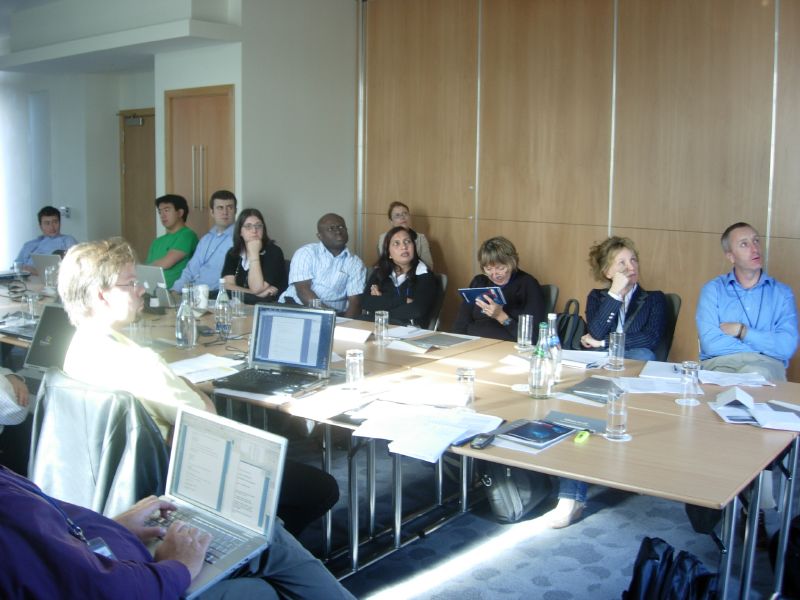
On the second day of the conference , our research group was involved in the organisation of a second workshop, dedicated to The Challenges of Collaborative Work in Global Software Development.
More details are available on the workshop page.

The first part was dedicated to paper presentations. We had 12 papers accepted for the workshop, looking at GSD from various angles, from theoretical approaches to highly pragmatic ones. It was quite a challenge for Gabriela to keep the time, but she was without mercy and warned speakers and discussants whenever they were tempted to exceed their time!

The workshop venue was probably the best in the whole Hilton Limerick, the City View suite. What wasn't the best was the audio installation in the room. We discovered this when we tested it at 8:50! Actually, the loud speakers where not working at all, and at 10 am we had scheduled the presentation of Julia Kotlarsky and Ilan Oshri who were in Warwick and supposed to give an online presentation via Skype and Yugma. We worked through this little "crisis" with the hotel staff, and after 30 min of trials the loudspeakers abandoned their strike and started working again (with a bit of a background noise, but working anyhow!) During all this time, the presentations in the room went on without major interruptions.


When the time came, Julia shared her desktop with us and delivered the presentation. The next paper belonged to Séamas Kelly and Camilla Noonan, and Seamas had to speak into the microphone in order to be heard by Ilan, who was the discussant for their paper. Most of the time, the communication went fine, with all the annoyance of the background sound. But we were all relieved when this episode finished...

We took a longer lunch break and went together to Luigi Malone's, where we enjoyed the company of the other workshop participants (and the food!). Walking through Limerick city centre in the lunchtime mild sun was a plus;)

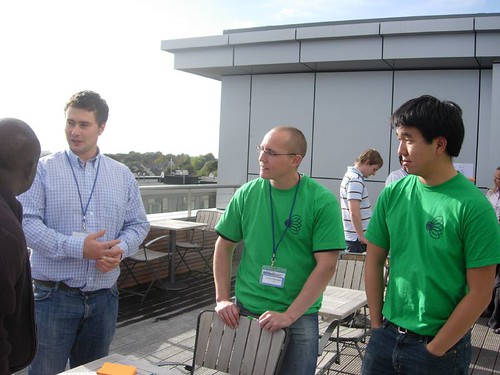
And the gorgeous weather allowed us to go out on the terrace and enjoy the beautiful view during the second part, when we had an Open Space. Topics were proposed, several groups formed, but the Open Space "law of two feet" wasn't applied too much! It looks like people were caught in one conversation and couldn't leave it very easy...


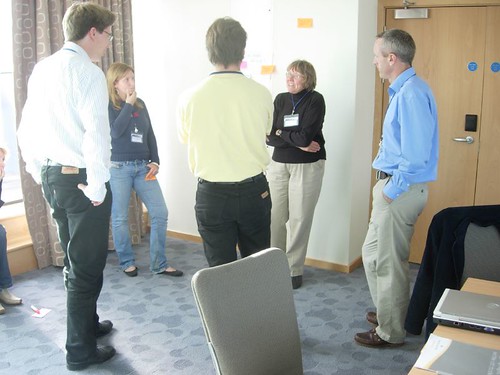
In the end , we had a short plenary session to communicate the conclusions. There's an audio recording of this session available for download, and the notes made by Gabriela and post-its were also shared.

A set of pictures is also available on Flickr.

As organisers, we were honoured to host the workshop, and we would like to thank again to all of you who attended! It was such an enjoyable experience!

Thursday, September 20, 2007

The ECKM'07 Conference in Barcelona

On September 6-7, Gabriela attended the 8th edition of the European Conference on Knowledge Management at Consorci Escola Industrial de Barcelona (CEIB), Spain.
The conference attracted a large number of participants this year, and 11 streams ran in parallel... A huge challenge - running from one room to another proved not to be the most effective strategy... Some titles were misleading, some presentations very poor, and you were always finding out during the break that you've missed an outstanding presentation that happened somewhere else...

But as always, the KM people were extremely good at networking and this made the conference pay off!

The first keynote speaker, Daan Andriessen from INHOLLAND, The Netherlands, spoke about Knowledge as Love: How Metaphors Direct our Efforts to Manage Knowledge in Organisations.
A bit shocking in the beginning, but the idea of the keynote was that the metaphor we use for referring to something as abstract as knowledge influences not only our vocabulary, but also our approach. If knowledge is treated as a resource, it can be stored, packaged, transferred. If knowledge would be treated as love, it would be all about relationship, trust, sharing and so on.

A few papers I found of interest:
- Disconnecting the Knowledge from the Knower - Jennifer Adelstein
- Knowledge Transfer Mechanisms - A Case Study From Manufacturing - Julie Boyd
- Technological Gatekeepers - Eoin Whelan

The second keynote speaker was Jan Annerstedt from Copenhagen Business School, Denmark on Intelligent Cities. The topic seemed interesting, but the presentation lacked any connection to KM.


The highlight of the conference was the Knowledge Cafe, ran by David Gurteen and dedicated to the Knowledge Metaphor. David posted Daan's slides, pictures and a few video interviews on the Gurteen Knowledge website. I set up a wiki page within the eckm wikispace to serve as placeholder for our knowledge metaphors.

My own paper - "Knowledge Work Practices in Global Software Development" was well received and initiated an interesting discussion. Why most of the virtual teams in the literature are made of software developers? Aren't there any other examples? What's the value of studying practices?

A few interesting contacts initiated at the conference:
- Andrea Fried, from Chemnitz University of Technology
- Igor Hawryszkiewycz, from The Sydney University of Technology
- Ved Prakash, from WIPRO Technologies, Bangalore
- Stella Van Rijn, from Nyenrode Business University
- Hanna Timonen, from the Helsinki University of Technology.

Hanna's research work has the same focus as ours: work practices. We explored the chances for a potential collaboration between our research groups and decided to stay in touch.

Thursday, August 30, 2007

The International Conference on Global Software Engineering

Gabriela and Anders are in Munich, attending one of the major conferences in our field - Gabriela as a speaker, Anders as student volunteer.

On Monday, the tutorials and workshops took place at the Technical University Munich in Garching ForschungsZentrum. We both attended the T4 tutorial: Seeing inside: Using social network analysis to understand patterns of collaboration and coordination in global software teams offered by Kate Ehrlich and Giuseppe Valletto (also co-organized by Mary Helander) from IBM Research.
The tutorial was interesting and attracted around 20 people. It looks like SNA is appealing to both researchers and practitioners - probably for quite a variety of reasons. While the first part of the tutorial was dedicated to the introduction of SNA basic concepts , the second was meant to show us how to extract social networks data from existing repositories like bug tracking systems, email and so on.

We had the chance to meet some of the most prominent researchers in our field (Daniela Damian, Phillipe Kruchten) and to socialize with colleagues (one of them, we discovered, was from Dublin, CA!)


A welcome reception at the Hilton City Munich followed on the same evening.

On Tuesday, instead of a keynote, there was an opening session including "two important papers"-as introduced by the organisers. Their topics - text-based communication in distributed requirements workshops and respectively the relationship between time zone separation and performance - were of great interest and therefore they were vividly discussed by the audience during the following breaks.


An Experience session, containing only papers from the industry, followed.

Before introducing the keynote speaker, Phillipe Kruchten presented some statistics: there were 100 submissions, out of which 29 were accepted; 156 participants were 60 from Germany, 22 from the US, 9 from the Netherlands, 8 from Finland, 5 from Canada, 4 from India, 3 from Japan. There were supposed to be 2 more Irish, but they didn't make it till the end.

25% of the participants were from academia, 35% from the industry, 19% came from research, 5% were consultants and 16% belonged to “other categories”. Strange enough, not a single person from this last category could be identified…

Then "Herr Professor Doktor" Erran Carmel delivered his keynote speech, "Reflections on a Decade of Studying Global Software Engineering".

A poster session followed - only 3 posters were presented, and unfortunately the Irish IBMers who were co-authors of one of them couldn't be there. Kate Ehrlich and Prof.Marilyn Tremaine had to stand next to it, explaining the work that had been done.

Sabrina Marczak from PUCRS, and a group of students from TU Munich(under the supervision of Marilyn Tremaine) were the authors of the other two.

In the afternoon, we had a session dedicated to Quality and Performance. Two very different talks. Rajesh Agarval from TCS presented the solution found by his company for motivating their developers to work as quality engineers as well. The other speaker was Timo Poikolainen from Nokia - and again, the audience had the chance to hear about successes and failures with thorough openness, as always when someone from Nokia is giving a presentation.

The session organized for students in the evening included two parts:

- In the first part, J.Sauer from Hamburg University presented the results of a survey he has undertaken on the particular difficulties of research in the GSE domain. It was interesting to listen to the student introductions – it gave you an idea of the differences between research settings in different countries.

- In the second part, Harold Ossher from IBM Watson introduced the Jazz Technology platform. Jazz is the result of a collaboration between IBM Rational and IBM Research and is attempting to build a team collaboration platform on top of the Eclipse IDE. Jazz.net – not yet open to the public; a few videos available. Two related research projects based on jazz were presented: one from Victoria University and the other one from University of California, Irvine.

And then the banquet, at the Ratshaus Keller. A lot of nice food and drinks, a magician going around and entertaining people, socializing and networking, and lots of fun.

On Wednesday, it was my turn (Gabriela's:), and I was extremely nervous. The session was titled Communication, and I was in very good company: Matt Bass from SEI-CMU (actually from Siemens!), and Luis Izquierdo, from the University of Victoria. Luis's paper was extremely interesting - his methods were also inspired by ethnography, and his field site very similar to ours.

I oscillated between a classical presentation and an unusual one. In the end, I couldn't resist the temptation - I went for the unusual one. I started with a warning - no figures nor tables in my presentation!

I don't know what was the impact at the conceptual level - if I managed to convince the audience how important social practices and human actors actually are in a global environment!, but probably my little SouthPark characters have made quite an impression!


On Wednesday afternoon, I had the honour of presenting to the steering committee the Lero proposal of organising ICGSE 2009 in Limerick.

Thursday, the last day of the conference, was shorter.
In the morning, the announcement was made that ICGSE 08 is going to take place in Bangalore, India, and ICGSE 09 in Limerick, Ireland.

In the first session, Michael Vax from LUXOFT delivered the keynote speech, substituting his boss who couldn't come because of visa problems.

The keynote was followed by an Experience session: Subita Sudershana from Roche Molecular Systems (very energetic talk, including stories of miscommunication with both parts speaking English!) , Viktor Clerc from VU Amsterdam, and Alexander Boden from University of Siegen.

The final session was dedicated to Processes and chaired by Daniela Damian. Alberto Avritzer from Siemens Corporate Research presented the Global Software Studio 3.0 project. Our own university was involved in the first and second year in this project, so it was interesting to see how it evolved in the next stage. Fausto Fasano spoke about an experiment on code inspection, while the final presentation (Rafael Prikladnicki from PUCRS) examined different offshoring and onshoring strategies.

Wednesday, August 08, 2007

Prof. Pekka Abrahamsson talk

Yesterday, myself and Gabriela went down to the LERO building here at UL to attend a talk by Prof. Pekka Abrahamsson. Pekka is at VTT in Finland and his research interests are centred on business and innovation agility, agile software production and empirical software engineering. Among other things, he is currently involved in VTT's Agile Software Technologies Research Programme and the FLEXI-ITEA2 project.

His talk here at UL had two parts: first, the talk shared unpublished results of an Idea Movement study where 50 000 mobile service ideas were collected from people of all age groups in Finland; the second part of the talk connects innovation processes and software development through agile software development models.

Two interesting topics, handled by a good (as well as very funny) speaker! One of the interesting observations from the Idea Movement project, that at least I appreciated, was that it seems like innovation achieved through interaction with the actual users on a large (huge) scale isn't technology driven but rather "idea-driven", as 95% of the ideas they received were quite possible to achieve with current technology. As Pekka put it: "the ideas that came out were framed in current technology."

Brian Fitzgerald organized the talk. He has known Pekka for many years, but his cluster project 3 group also have current connections to VTT and Pekka, since one of the research fellows, Minna Pikkarainen, is from there.

Thursday, August 02, 2007

Summer guests

Today we had not one, but two guests here at UL. Both also gave talks (organised by Chris Exton in association with the CSCoP).


The first talk scheduled in the morning was Michael Kölling's from the University of Kent.
Titled "Greenfoot - An Interactive Platform For Introducing Programming", the talk introduced a framework Michael has developed for introducing beginning students to programming.
"Greenfoot allows starting to program with interactive graphical simulations, computer
games and other graphical scenarios. One of the main aims of Greenfoot is to create a motivating, creative, diverse entry to the learning of programming, that engages larger groups of students, including those not traditionally well represented in our degree intake.
Greenfoot uses the Java Programming Language, and was originally designed to be used as a first platform, especially at the high school level, before students then migrate to other environments. "
Michael also writes an interesting blog. What a pity Muireann was not here anymore! This could be the perfect approach for her students!

The second talk was by Alexander Troussov, the Chief Scientist of the IBM Dublin Center for Advanced Studies who initially facilitated our connection with the team we've been observing for 16 months and supported our socGSD field studies inside IBM .
The topic of the talk was "Socio-semantic computing in IBM and the EU project Nepomuk"

Alexander spoke about the launch of Lotus Connections (social software for business designed to help build social networks in the corporate environment)

According to some analysts, the release of Lotus Connections means that "the
company is serious about dominating social networking for the enterprise".

Alexander gave an introduction into the new emergent area of socio-semantic computing, and presented Galaxy -the tool for socio-semantic computing created in the IBM Dublin Software Lab, which is part of the deliverables in the FP6 project Nepomuk aiming to build a social semantic desktop (for more detail, also see Nepomuk on Bibsonomy).

(the slide belongs to a set presented at the Irish Digital Libraries Summit)
Alexander demonstrated the tool in front of the audience, showing how it manages to collect semantic information from a variety of sources.

In the afternoon, the two guests honoured us with their presence in the Interaction Design Centre, discussing their ideas and possible collaboration opportunities.

Friday, July 27, 2007

Muireann's time with the socGSD team coming to an end...

Today was Muireann's last day with us. We enjoyed a lot having her around this summer as a STARs teacher, and in a short time she has become part of our team.

She sat in most our team meetings during this period, joined us in attending talks and presentations, gave her moral support to our OSS conference presentation and participated as an observer in our recent meeting with the advisory group. She spent time with each of us, getting acquainted with our specific research interests, career trajectories and work.

She was also given the chance to meet with some of our colleagues in Lero: Ita Richardson, Brian Fitzgerald, Irene Caulfield, Val Casey, Sadhana Deshpande.

Pamela O'Shea gave her a Linux crash course. Gabriela tried to pass her the social software bug;-)

Our colleagues in the IDC adopted her as well, and she had the chance to find out about the other ongoing projects.
We were more than happy to have Muireann here with us for the summer, and she's more than welcome to visit the IDC in the future! We hope to keep in touch with her and her school in Carrigaline in the future...

Goodbye, Muireann, and thank you!

Sunday, July 22, 2007

Getting feedback on our work to date...

On Wednesday, July 17, our team had the chance to meet with our advisory group again (last meeting was in September last year).

James Wickham (from Trinity College Dublin), Seamas Kelly and Pamela Abbott (from University College Dublin) visited us for a day to discuss our research to date.

The whole team was present (Prof.Liam Bannon, Gabriela Avram, Anders Sigfridsson, Daniel Sullivan, Anne Sheehan and Michael Cooke). Muireann O'Brien, our STARs guest for the summer, joined us as well.
The morning was dedicated to presentations. Liam opened the meeting, presenting the current status of our research.
  • Anne came next, speaking about her work together with Anders on positioning our own work in the landscape of Global Software Development;
  • Anders spoke about our approach in studying the PyPy Open Source community using situated learning as lens; in connection with this, he commented on his intentions to focus his PhD thesis on learning in the workplace;
  • Daniel made an introduction in the topic of his master thesis (Defect Tracking Systems) and presented his latest observations from recent fieldwork.
  • Gabriela spoke about her field observations on collaborative work practices in GSD and the major topics she sees evolving: tools adoption, e-meetings, social networking in the corporate environment.
The ideas in each presentation were commented in detail both by our guests and by the other participants.

The afternoon was dedicated to discussing the current stage of our research and the future plans.

We all found the discussions extremely useful for our work. It was a real work meeting, in which we put into light both the strengths and the weaknesses we could see in our work and got useful feedback from the members of the advisory group (and Liam!). They confirmed the value of our approach and encouraged us to continue on the same lines.

Sunday, July 15, 2007

IBM innovation Centre opening July 11th 2007 at Damastown

Daniel attended this recent IBM event and is sharing his notes here:

As was previously announced by the former future leader of the main party in government and minister for Enterprise IBM have this past week opened what they describe as an Innovation Centre. It is very nice facility in part of building 6

I missed the introduction from Hans Ulrich Maerkl, Chairman of IBM EMEA as I had some other matters to attend to.

I came in just as the talk from Jim Corgel was hitting its stride it was primarily aimed at Venture Capitalists and companies that are thinking of partnering with IBM and he spoke of the ongoing roll out of Innovation centres or similar type facilities around Europe and he also spoke of the types of virtual supports that there will be.

Next up, we saw a video from Porto Media which was quite twee (as the owner himself admitted but the idea is very good - essentially you can download media such as movies in less than 20 secs to a USB stick from a Kiosk that can be placed anywhere. The kiosk takes up a sq metre of floor space and compared to say Blockbuster which has 8/900 moives per store, this device can have 4/5,000 movies. After the video we heard from the company’s owner Chris Armstrong who spoke about the problems of being taken seriously by the Venture Capital community in Ireland.

Next was BiancaMed, who are in the medical devices area. This may perhaps be more interesting from an wider IDC perspective. They is involved in proactive, non invasive monitoring of sleep, diet and exercise as part of its efforts in enhancing well-being. (I know it sounds a little too like a line from Lenina Husley in Demolition Man- " Enhance your calm, John Spartan") That said, I'd be curious about the technology, they use audio that gets analysed to monitor heart rate breathing and so on.

Next, Deborah Magid from IBM then spoke more about what IBM gives for Partner organisations. This presentation was a bit more buzzwordy. I'm pretty sure I heard synergy being used at least once. That said, IBM are really pushing that they are interested in partnering with companies and that they are interested in VCs funding some of those companies.

We broke for coffee at this point and there was some mingling.

Sandra Kearney - spoke at length about Web 2.0 and how Internet 3D is what IBM believes is the next stage in the web. She uses it herself to manage her teams who are distributed across Australia, the US and SE Asia. A ex-military person and pilot with 1500 hours flight time, I recall she mentioned 130s so I'm guess it was C130s.

Msoft spoke about how they use 2nd life for demoing what their product is all about. Their product is for tracking blood product in a hospital/clinical environment.

Nic Brisbourne spoke again about the VC environment and the opportunities involved. Only tangential about virtual worlds and 3D internet. If you click the link on his name you can read his perspective on the opening.

Ham Rambler or John Mahon (who is a pilot) spoke about Dublin in 2nd Life which he created and how that has been going. Talked about audio streaming and live music being played within 2nd life and how money can be made by the players of the music.

Then we had lunch - sandwiches on the go - and a tour of the new area. I spoke with Alexander Troussov about their work on Galaxy, it is quite intriguing and also the Lotus Connections work is interesting. Overall there was a pretty heavy business emphasis to the day and a considerable media in attendance. There were well over 200 people in all.